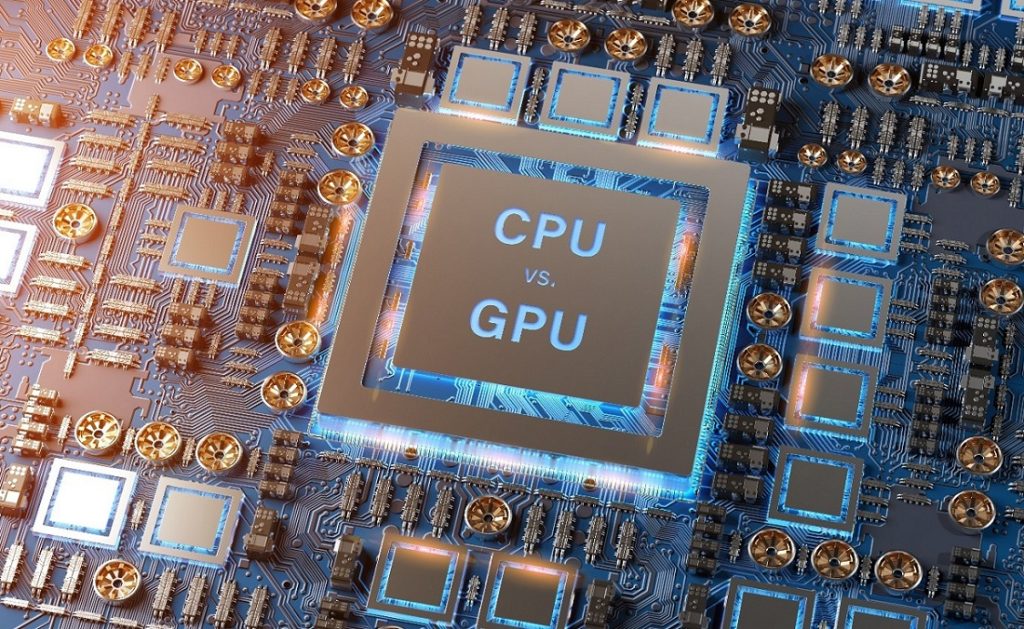


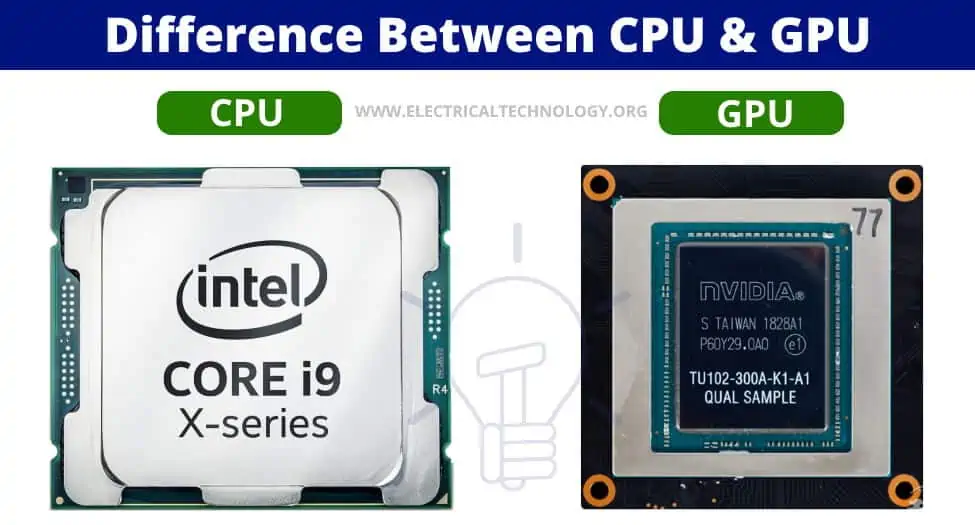
A CPU (Central Processing Unit) is a general-purpose processor that handles a wide range of tasks sequentially, making it ideal for operating systems and applications. A GPU (Graphics Processing Unit) is a specialized processor with thousands of cores designed for parallel processing, excelling at tasks like graphics rendering, gaming, and machine learning.
| Feature | CPU (Central Processing Unit) | GPU (Graphics Processing Unit) |
|---|---|---|
| Purpose | General-purpose processing | Specialized for graphics and parallel tasks |
| Architecture | A few, very powerful cores | Thousands of simpler, specialized cores |
| Processing Style | Handles tasks one after another (serial) | Handles many tasks at the same time (parallel) |
| Best for | Running operating systems, managing applications, and performing single large tasks | Gaming, video rendering, 3D graphics, machine learning, and scientific simulations |
What are CPU and GPU?
A CPU (Central Processing Unit) is a general-purpose processor that handles a wide range of tasks, while a GPU (Graphics Processing Unit) is a specialized processor designed for handling complex visual and mathematical calculations, especially in parallel. The main difference is that a CPU has fewer, more powerful cores for sequential tasks, while a GPU has thousands of smaller cores optimized for parallel processing.
CPU (Central Processing Unit):
- Function: The “brain” of the computer that handles system management, runs applications, and processes data for general-purpose computing.
- Architecture: Features a small number of very powerful cores (e.g., 2 to 64) designed for speed and low latency.
- Processing: Excels at serial tasks, or handling one large task at a time efficiently.
- Use Cases: Operating system tasks, running applications, general data processing, and managing hardware.
GPU (Graphics Processing Unit):
- Function: A specialized processor originally built to accelerate graphics and video rendering.
- Architecture: Features thousands of smaller, more specialized cores to handle many tasks simultaneously.
- Processing: Excels at parallel processing, or handling a multitude of smaller, independent tasks at the same time.
- Use Cases: Gaming, video editing, 3D rendering, machine learning, and other high-performance computing tasks that can be broken down into smaller chunks.
Which is better, a CPU or a GPU?
Neither is definitively “better”; it depends on the task, as CPUs are better for sequential tasks while GPUs excel at parallel processing. For general computing, a CPU is essential, while for intensive tasks like gaming, video editing, or AI, a powerful GPU is crucial. The best choice depends on whether the work is a single complex problem (CPU) or many simple problems that can be solved at once (GPU).
CPU (Central Processing Unit):
- Role: A general-purpose processor for the main functions of a computer.
- Strengths: Handles a wide variety of tasks, especially those that are sequential (one after another). It has fewer, more powerful cores designed for quick, serial instruction processing.
- Best for: Running operating systems, applications, and general computing tasks where a single, large task is performed at a time.
GPU (Graphics Processing Unit):
- Role: A specialized processor originally designed for rendering graphics.
- Strengths: Contains thousands of smaller cores that can perform many calculations simultaneously (in parallel).
- Best for: Tasks that can be broken down into smaller, independent parts, such as:
- Gaming (rendering detailed graphics and high frame rates)
- Video editing and content creation
- Machine learning and scientific computations
Which one to choose?
- For general use or gaming with less demanding graphics, a strong CPU is often sufficient.
- For high-end gaming, video rendering, or machine learning, a powerful GPU is a must.
- In a balanced system, both are critical. A high-end GPU needs a capable CPU to avoid becoming a bottleneck, and a powerful CPU can’t achieve its full potential without a strong GPU for graphical tasks.
What is the full form of GPU?
GPU stands for Graphics Processing Unit. It is a specialized electronic circuit designed to accelerate the creation of images and videos by processing large blocks of data simultaneously. GPUs are also commonly called graphics cards or video cards.
Function:
Originally developed for gaming, GPUs are now used for a wide range of computationally intensive tasks that benefit from parallel processing, such as video editing, machine learning, and scientific simulations.
Parallel processing:
They excel at handling many calculations at the same time, which makes them much faster than a Central Processing Unit (CPU) for these types of jobs.
Before you purchase a new computer you should know this >>
Is GPU included in CPU?
No, a GPU is not part of a CPU, but they can be integrated or separate components. A CPU is the general-purpose “brain” of the computer, while a GPU is a specialized processor designed for parallel tasks like rendering graphics. In some systems, the GPU is a separate, discrete card (a discrete GPU), while in others, it is a smaller chip embedded alongside the CPU (an integrated GPU).
CPU vs. GPU
| Feature | CPU (Central Processing Unit) | GPU (Graphics Processing Unit) |
|---|---|---|
| Primary Function | Handles a wide variety of general computing tasks | Renders images, video, and performs other complex parallel calculations |
| Architecture | Fewer, more complex cores designed for sequential and varied tasks | Many, simpler cores designed for massive parallel processing |
| Performance | Efficient at handling diverse instructions and complex decisions quickly | Much faster at performing the same type of simple calculation on large amounts of data at once |
Types of GPUs
- Discrete GPU: A separate component, typically on its own circuit board, with its own dedicated memory (VRAM). It is a separate chip from the CPU.
- Integrated GPU: A smaller GPU chip built directly into the same physical package as the CPU. It shares system memory with the CPU.
What is a CPU?

A CPU, or Central Processing Unit, is the “brain” of a computer that executes instructions from programs and performs calculations to carry out tasks. It is a primary hardware component that fetches instructions from memory, decodes them, and then executes them, making it essential for any computer to function. CPUs are found in a wide range of devices, from desktops and smartphones to servers in data centers.
- Core function: The CPU acts as the control center, processing commands from software and directing other components to carry out the necessary actions.
- Key operations: It performs all basic logical and arithmetic operations and manages the flow of data and instructions to execute a variety of tasks.
- Performance: The speed of a CPU, typically measured by its clock speed, determines how quickly a computer can process information and respond to commands.
- Analogy: The CPU is often compared to the brain because it is the core component that allows a computer to “think” and process information. However, it is important to note that the software provides the instructions, while the CPU executes them.
- Ubiquitous: CPUs are found in virtually all computing devices, including personal computers, mobile phones, and servers, powering everything from apps and games to websites like Google and YouTube.
Can a computer run without a CPU?
No, a PC cannot run without a CPU because it is the central processing unit that executes all instructions, performs calculations, and runs programs. Without a CPU, the computer is essentially a heap of parts and will not boot up, turn on, or display anything on the screen.