


The actual utility of a Solid State Drive (SSD) in a computer lies in its fundamental design difference from traditional hard disk drives (HDDs): it uses integrated circuits (flash memory) to store data persistently rather than spinning mechanical platters [1]. This results in several significant practical advantages:
Primary Utility: Speed
The most impactful utility of an SSD is its dramatically faster speed compared to an HDD. This speed manifests in several key areas:
- Faster Boot Times: Computers equipped with an SSD load the operating system (like Windows or macOS) much quicker, often in seconds rather than minutes [1].
- Rapid Application Loading: Programs, especially large applications like video editors, games, or creative suites, open significantly faster [1].
- Improved Overall Responsiveness: Daily tasks such as opening files, searching for data, and multitasking feel instantaneous and smooth [1]. The elimination of mechanical seek time (the time it takes for an HDD’s read/write head to find data) is the primary reason for this boost [1].
Secondary Utilities: Durability, Efficiency, and Quiet Operation>>
Beyond raw speed, the SSD’s design provides other essential utilities:
- Durability and Reliability: Since SSDs lack moving parts, they are far more resistant to physical shocks, drops, and vibrations than HDDs [1, 2]. This makes them ideal for portable devices like laptops, which are frequently moved around [1].
- Energy Efficiency: SSDs consume less power than HDDs, which means longer battery life for laptops and lower energy costs for data centers and desktop PCs [1, 2].
- Silent Operation: Without spinning platters or moving read/write heads, SSDs produce zero noise, contributing to a quieter computing environment [1, 2].
In summary, the actual utility of an SSD is to eliminate the performance bottleneck caused by mechanical storage, making the entire computer system feel faster, more robust, and more efficient.
What does an SSD actually do?
An SSD, or Solid-State Drive, is a data storage device that works by storing information on integrated circuits, resulting in faster performance, greater durability, and silent operation compared to traditional hard disk drives (HDDs). It is used to store your operating system, applications, and files, making your computer boot up faster, launch programs quicker, and load games with less delay.
What an SSD does>>
- Stores data: An SSD’s primary function is to store digital data, such as your operating system, documents, photos, and applications.
- Provides fast access: It significantly speeds up data access because it uses flash memory and electronic circuits instead of the mechanical, moving parts found in older HDDs. This leads to faster boot times and quicker program launches.
- Improves performance: By providing faster data transfer to the computer’s RAM, an SSD makes your entire system feel more responsive and can improve the performance of demanding applications like games.
- Offers greater durability: Because it lacks moving parts, an SSD is more resistant to physical shock, making it less likely to be damaged by drops or jostling than an HDD.
- Reduces noise and heat: With no spinning platters, an SSD is completely silent and generates less heat than a traditional hard drive.
- Enables slimmer devices: Their smaller size allows for thinner and lighter laptop designs compared to older, bulkier HDD technology.
How many GB SSD is best?
SSD Comparison Table:
| Capacity | Speed | Recommended Use |
|---|---|---|
| 512 GB | Adequate (≈3,000-5,000 MB/s) | Office work, light use |
| 1 TB | Fast (5,000-7,000 MB/s) | Gaming, multimedia |
| 2 TB | Very fast (7,000-10,000+ MB/s) | Content creation, workstation |
Will SSD make PC faster?
SSDs are generally faster and more reliable than HDDs, but are also more expensive. If you need fast boot and load times, improved overall system performance, and can afford the higher cost per gigabyte, then an SSD is worth it. If you need a larger storage capacity at a lower price, an HDD may be the better option.
What is the main disadvantage of an SSD?
The main disadvantage of an SSD is the price per gigabyte compared to an HDD. Traditionally, HDDs can store much more data on a single drive; however, SSDs are becoming increasingly available in drives with comparable storage. This makes high-storage HDDs significantly cheaper when priced per gigabyte.
Is RAM still faster than SSD?
Even though SSDs are faster than HDDs, they’re still slower than RAM. There are two reasons for that difference in speed. First, the memory chips in SSDs are slower than those in RAM. Second, there is a bottleneck created by the interface that connects the storage device to the computer.
What are the three types of SSDs?
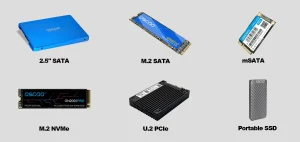
The three main types of SSDs are SATA, NVMe, and M.2. SATA SSDs are the most common, using a connection like traditional hard drives. NVMe SSDs are faster, using the PCIe interface for high performance. M.2 is a form factor that can support either SATA or the much faster NVMe protocols.
SATA SSDs:
- Description: These use the same interface as traditional Hard Disk Drives (HDDs) and come in a 2.5-inch form factor that is compatible with most desktops and laptops.
- Performance: They offer a significant speed improvement over HDDs but are limited by the SATA interface, providing speeds of up to approximately
550550550 MB/s.
NVMe SSDs:
- Description: These use the Non-Volatile Memory Express (NVMe) protocol, which is optimized for the high speeds of flash storage. They are designed to connect directly to the motherboard’s PCIe slots for faster data transfer.
- Performance: They are considerably faster than SATA SSDs, with speeds often exceeding
3,5003 comma 5003,500 MB/s.
M.2 SSDs:
- Description: M.2 refers to the compact form factor of the drive, not the interface. An M.2 SSD can use either a SATA or a PCIe (NVMe) interface.
- Performance: Performance varies depending on the protocol. M.2 SATA drives are similar in speed to traditional 2.5-inch SATA drives, while M.2 NVMe drives are the fastest, using the high-speed PCIe interface.
Do laptops need SSD?

Yes, an SSD is very important for a laptop because it significantly improves performance, making it faster and more responsive for everyday tasks. Compared to traditional hard disk drives (HDDs), SSDs offer much faster boot times, quicker application launches, and better multitasking due to their use of flash memory instead of mechanical parts. They are also more durable, consume less power, and are quieter and cooler.
Key benefits of an SSD:
- Faster performance: SSDs have much faster read and write speeds, which means your laptop boots up quicker, applications open almost instantly, and files are accessed in a fraction of the time.
- Improved responsiveness: Because SSDs don’t have moving parts to spin up, they provide a more responsive user experience, allowing you to multitask smoothly with little to no lag.
- Increased durability: Without any moving parts, SSDs are far more resistant to physical shock, drops, and bumps, making them a more reliable choice for a portable device like a laptop.
- Better battery life: Since SSDs require less energy to operate than HDDs, they can help increase your laptop’s battery life.
- Lower heat and noise: SSDs generate less heat and operate silently, contributing to a cooler and quieter laptop environment.
When to choose an SSD over an HDD:
- For operating systems and applications: An SSD is the best choice for your operating system and frequently used programs to ensure the fastest possible performance.
- For a full upgrade: Upgrading from an old HDD to an SSD is one of the most impactful ways to make an older laptop feel like new again.
What shortens SSD lifespan?
Excessive heat accelerates wear, power loss can corrupt data, and frequent large writes shorten lifespan. Though SSDs are more shock-resistant than HDDs, physical impact can still cause damage.
To know more kindly click on to reference link: https://www.google.com/search?q=what+is+the+actual+utility+of+ssd+in+a+computer&rlz=1C1CHBD_en-GBIN1169IN1169&oq=What+is+The+Actual+Utility+of+SSD&gs_lcrp=EgZjaHJvbWUqBwgCECEYnwUyBggAEEUYOTIHCAEQIRifBTIHCAIQIRifBTIHCAMQIRifBTIHCAQQIRifBTIHCAUQIRifBTIHCAYQIRifBTIHCAcQIRifBTIHCAgQIRifBTIHCAkQIRifBdIBCTMzNDU5ajBqN6gCCLACAfEFid-lvaBAw0XxBYnfpb2gQMNF&sourceid=chrome&ie=UTF-8