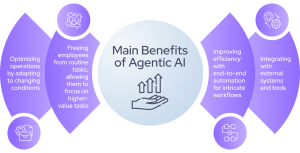

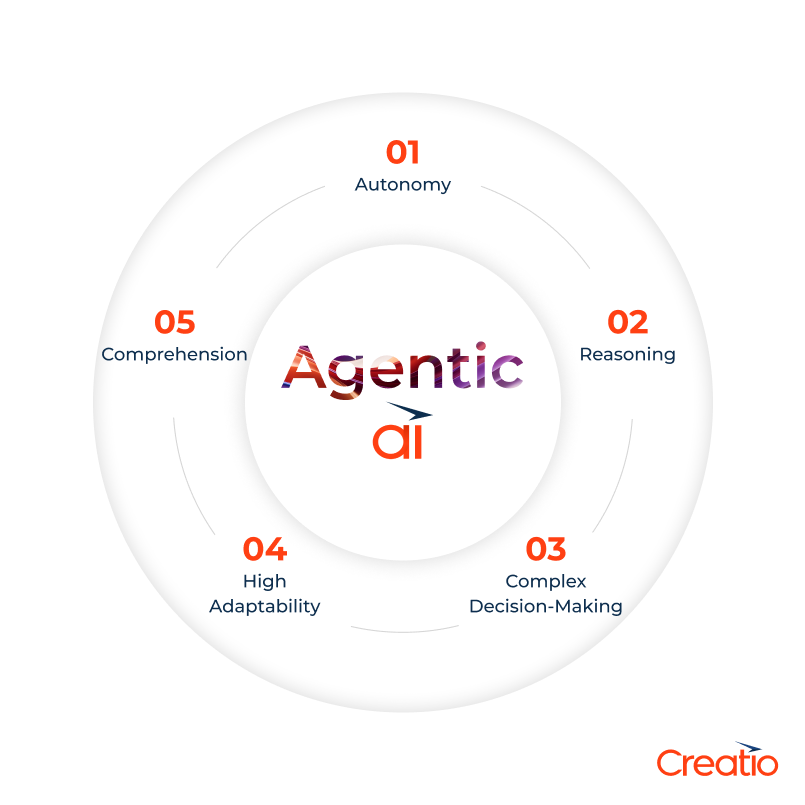
Agentic AI refers to autonomous AI systems that can independently set goals, plan multi-step solutions, use tools (like APIs and databases), and take actions to achieve complex objectives with minimal human intervention, moving beyond simple generative tasks to actively “do” things in the real world. Unlike basic chatbots, agentic AI systems demonstrate agency by reasoning, learning, and adapting to execute workflows, making them powerful for automating complex processes across various applications.
Key Characteristics:
- Autonomy & Agency: Acts independently to achieve goals, setting its own sub-tasks.
- Planning & Reasoning: Uses sophisticated logic to break down complex problems and devise strategies.
- Tool Use: Integrates with external tools, APIs, and databases to gather information and perform actions.
- Contextual Understanding: Maintains memory and adapts behavior based on dynamic information and changing conditions.
- Multi-Step Execution: Manages entire workflows, from initial analysis to final action, often collaborating with other agents.
How It Differs from Generative AI:
- Generative AI: Focuses on creating content (text, images) in response to prompts (e.g., a chatbot answering a question).
- Agentic AI: Goes further to act on the world, using generative models as a core component but adding planning, tools, and autonomy to complete tasks (e.g., checking an account, making a transaction).
Examples & Applications:
- Customer Service: An agent checks balances, recommends accounts, and processes payments.
- Business Automation: Orchestrates complex workflows across different software systems.
- Research: Independently searches, analyzes data, and synthesizes findings.
Agentic AI refers to a class of autonomous artificial intelligence systems designed to independently plan, reason, and take actions to achieve complex goals without step-by-step human guidance. Unlike traditional or purely generative AI, which primarily respond to specific prompts or follow rigid rules, agentic systems exhibit “agency”—the ability to perceive their environment, evaluate options, and adapt their strategies in real-time.
Core Characteristics:
- Autonomy: They operate with minimal oversight, making decisions on the best path to reach an objective rather than just generating content.
- Goal Orientation: Users provide a high-level outcome (e.g., “organize a marketing campaign”), and the system breaks this down into actionable sub-tasks.
- Adaptability: These systems use feedback loops to learn from failures and change their approach if initial plans do not work.
- Tool Use: They can interact with external software via APIs, such as querying databases, sending emails, or managing financial transactions.
Key Components of the Architecture:
- Perception: Gathering data from diverse sources like sensors, databases, and user inputs.
- Reasoning Engine: Usually a Large Language Model (LLM) that serves as the “brain,” analyzing context and formulating plans.
- Memory: Retaining context through short-term memory (for the current task) and long-term memory (for historical patterns and preferences).
- Orchestration: Managing multiple specialized agents that collaborate to solve multi-domain problems.
What is the concept of agentic AI?
Agentic AI involves autonomous AI systems that can set goals, plan, and execute complex, multi-step tasks independently, going beyond simple responses to take proactive, real-world actions using tools, memory, and continuous learning, integrating technologies like LLMs, APIs, and workflow orchestration for advanced automation. Key concepts include autonomy, goal-orientation, planning, tool use, memory, learning/adaptation, and often multi-agent systems, enabling sophisticated, human-like problem-solving with less human oversight.
Core Concepts:
- Autonomy: The ability to operate and make decisions without constant human guidance, handling complex workflows on their own.
- Goal-Orientation & Planning: Defining objectives and breaking them down into sub-tasks, then devising and executing plans to achieve them.
- Proactive Action: Moving from just generating content (like Generative AI) to actively doing things in the real world.
- Tool Use & Integration: Connecting with APIs, databases, and software to gather information and perform actions (e.g., searching the web, making API calls).
- Memory: Retaining context and past experiences to inform future decisions, crucial for complex, multi-step tasks.
- Learning & Adaptation: Improving performance over time by learning from feedback and adapting behaviour to changing conditions or obstacles.
- Reasoning & Perception: Interpreting complex data and situations, making context-dependent judgments.
- Multi-Agent Systems: Networks of specialized AI agents that can collaborate with each other and other systems to solve problems.
How it Works (The Agentic Loop):
- Perceive: Gather data from the environment (user input, external data, sensors).
- Reason/Plan: Use an LLM/reasoning engine to understand the goal, plan steps, and decide on actions.
- Act: Execute tasks using integrated tools (APIs, databases).
- Learn/Reflect: Analyze outcomes and adjust strategies for better future performance (using techniques like reinforcement learning).
Key Differentiators:
- Vs. Traditional AI: Agentic AI is autonomous and proactive, whereas traditional AI is typically reactive or rule-based.
- Vs. Generative AI: Generative AI creates content (text, code); Agentic AI executes complex workflows and real-world actions to achieve goals.
Is Chat GPT an agentic AI?
Yes, Chat GPT can function as an AI agent, especially with its newer “agent” features that allow it to perform multi-step tasks, browse the web, and use tools, but fundamentally, it’s a powerful language model that becomes an agent when integrated with capabilities to take action, moving beyond just conversation to autonomous task execution like booking flights or managing calendars. In its basic form, it’s a chatbot; with tools and autonomy, it acts as an agent, making the distinction about implementation and functionality.
Key Differences & How Chat GPT Fits In:
- Basic ChatGPT: A reactive language model good at conversation, answering questions, and generating text but needs constant prompts and can’t act independently.
- AI Agent: An autonomous system that plans, prioritizes, and executes tasks, often involving external tools and environments (like a virtual computer).
- Chat GPT as an Agent: When you enable features like web browsing, data analysis, or code execution within Chat GPT (often for paid users), it starts acting like an agent by using its language skills to orchestrate these actions, research, and complete complex workflows.
In Summary:
While the core technology (GPT) is a language model, its application as an “AI agent” involves giving it the ability to do things autonomously, bridging the gap between answering questions and performing real-world tasks.
What is the difference between AI and agentic AI?
Agentic AI is an advanced form of artificial intelligence that can plan and execute complex tasks across multiple systems to achieve specific goals. Unlike traditional AI, agentic AI makes decisions, uses various tools and APIs, and performs sequences of actions without continuous human guidance.
What are some examples of agentic AI?
AI Overview
Agentic AI examples include autonomous systems like self-driving cars, AI coding assistants (e.g., GitHub Copilot), and virtual agents for customer service (e.g., Salesforce’s event agent) that plan and execute multi-step tasks, integrating tools and APIs to achieve goals with minimal human oversight, found in areas from healthcare (diagnosis) to finance (fraud detection) and e-commerce (personalized shopping). These systems go beyond simple responses, acting as autonomous collaborators to solve complex problems.
Real-World Examples & Use Cases
- E-commerce & Retail: Agents manage dynamic pricing, inventory replenishment, cart recovery, and personalized shopping assistants.
- Customer Service: AI virtual agents handle complex workflows for refunds, scheduling, and policy interpretation, freeing human agents.
- Software Development: Tools like {GitHub Copilot} assist with code generation, debugging, and automated testing.
- Finance: Agents monitor transactions for fraud, manage algorithmic trading, and provide AI-driven investment advice.
- Healthcare: AI agents analyze medical data for diagnosis, personalize treatment plans, and automate administrative tasks like prior authorizations.
- HR & Operations: Autonomous agents manage onboarding, process IT requests, and answer complex policy questions for employees.
- Supply Chain: Agents optimize logistics, predict demand, and automate inventory reordering.
- Autonomous Systems: Self-driving cars use agentic AI to make real-time driving decisions, while robotics uses them for complex tasks like search and rescue.
How They Work (Key Characteristics):
- Goal-Oriented: Define objectives, not just tasks (e.g., “improve customer retention” vs. “answer support ticket”).
- Tool Use: Call external APIs and use various tools (browsers, databases, code interpreters).
- Reasoning & Planning: Break down complex problems into multi-step plans.
- Adaptability: Learn from interactions and feedback to improve performance.
Is Tesla agentic AI?
Perhaps the most well-known example of agentic AI in action is Tesla’s autopilot and Full Self-Driving (FSD) technology. While not fully autonomous, these systems automate many aspects of driving through a complex network of workflows, such as monitoring speed, location, and surrounding objects.
Who is using agentic AI?
Google has actively positioned itself at the forefront of “agentic AI” — building systems that don’t just react but plan, select tools, act and learn across workflows. Their push is especially strong in research & development contexts, enterprise agent orchestration, and large-scale agentic infrastructure.
Who are the big 4 AI agents?

“Big 4 AI agents” can refer to two different groups: the major tech companies leading AI development (like Open AI, Google, Microsoft, and Anthropic) or the “Big Four” consulting/accounting firms (Deloitte, PwC, EY, and KPMG) using advanced AI agents for client work and internal processes. These firms are deploying agentic AI—autonomous systems that perform multi-step tasks with minimal human input—in areas like audit, tax, and risk management, transforming traditional service models.
Tech Giants (Foundational AI)
- OpenAI: Known for foundational models like GPT, powering many other applications.
- Google (DeepMind): A leader in AI research, integrating AI across its vast product ecosystem.
- Microsoft: Leverages OpenAI’s models and builds AI into its Azure cloud and Copilot products.
- Anthropic: A key player focusing on safe and powerful AI models, often seen as a major competitor.
Consulting/Professional Services (Application & Implementation)
- Deloitte: Developing AI agents for audit, expense management, and market analysis.
- PwC (PricewaterhouseCoopers): Using AI for complex tasks in audit, tax, and advisory services.
- EY (Ernst & Young): Implementing agentic AI to automate and redefine processes, particularly in tax.
- KPMG: Investing heavily in AI for internal efficiency and client-facing solutions, competing in the agentic AI space.
Key Difference: Generative vs. Agentic AI:
- Generative AI (like chatbots): Responds to prompts with generated content.
- Agentic AI: Can reason, plan, and execute complex, multi-step tasks autonomously to achieve a goal, marking the next wave of AI adoption.