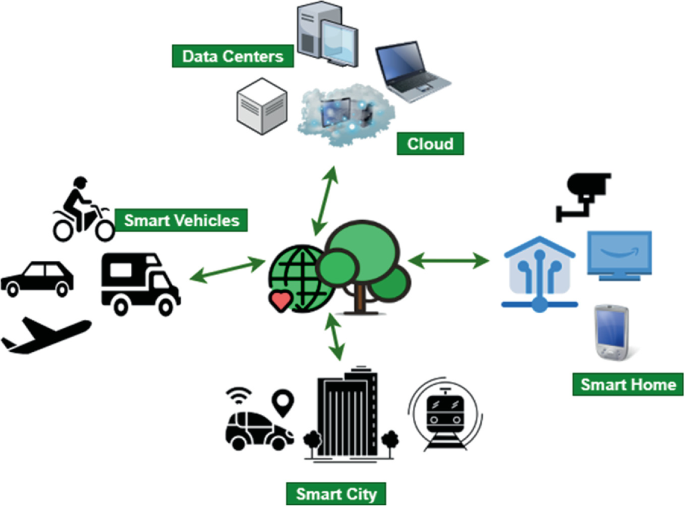

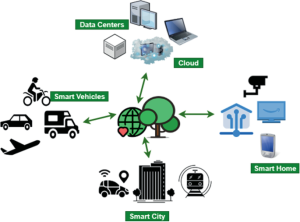
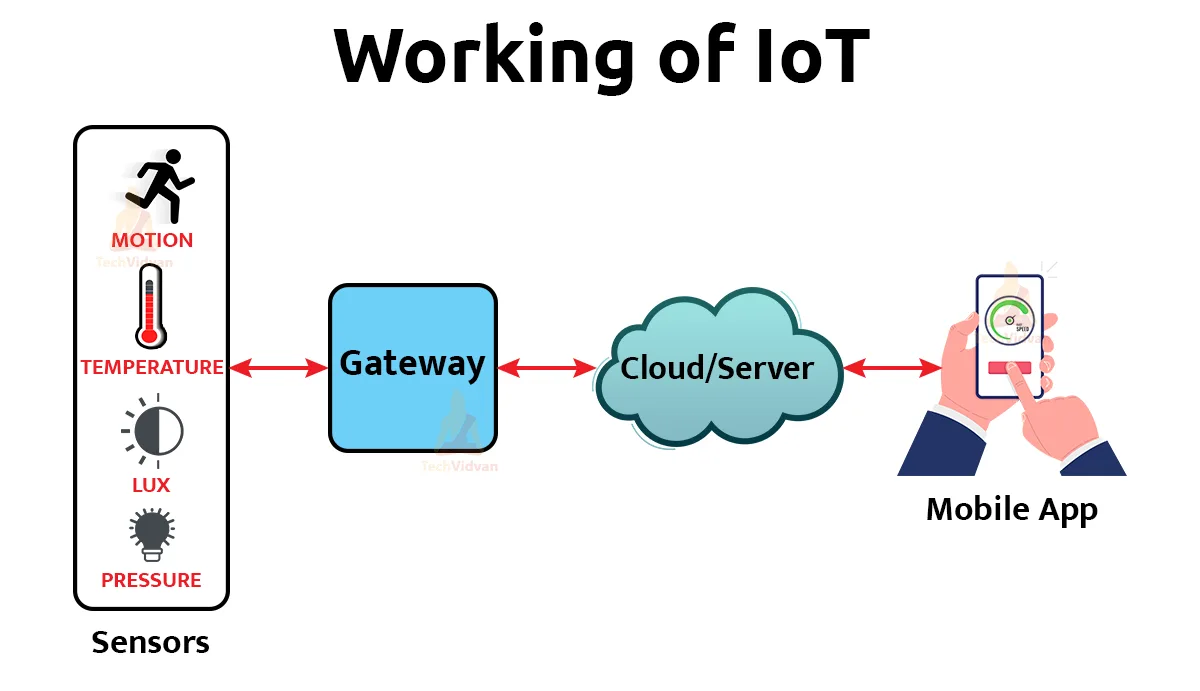
IoT devices work by using sensors to collect data from their surroundings, sending it over the internet (via Wi-Fi, Bluetooth, cellular) to a cloud platform for processing, where software analyzes the data to make decisions, and then sending commands back to the device or other devices to trigger actions, creating a cycle of data collection, analysis, and automated response for enhanced convenience and efficiency.
Here’s a breakdown of the core process:
- Sensing & Data Collection: Devices (smart speakers, thermostats, wearables) have embedded sensors that gather real-time information about the environment or their own status (temperature, motion, usage).
- Connectivity: This collected data is transmitted wirelessly (Wi-Fi, Bluetooth, cellular) to an IoT gateway or directly to the cloud.
- Data Processing (The Cloud): In the cloud, data is aggregated, processed, and analyzed by software and AI/machine learning algorithms to find patterns or insights.
- Action & Control: Based on the analysis, the system sends commands back to the device or other connected devices, triggering an action (e.g., turning on lights, sending an alert) or providing user control via an app.
- User Interface: Users can monitor and control these devices remotely through mobile apps or web dashboards, receiving insights and making adjustments.
This continuous loop allows devices to learn user behaviour and automate tasks, making everyday objects “smarter” and more responsive.
Internet of Things (IoT) devices work by collecting environmental data through sensors, transmitting it via various connectivity protocols to a central system (often the cloud), and processing it to trigger specific actions or insights.
The Four-Stage Workflow>>
The functioning of an IoT system is generally categorized into four core stages:
- Data Collection (Sensors/Devices): Physical objects use embedded sensors to gather data from their surroundings, such as temperature, motion, moisture, or even video feeds.
- Connectivity: The collected data is sent to a processing hub using various network protocols. Common options include:
- Short-range: Bluetooth, Wi-Fi, and Zigbee.
- Long-range: Cellular (4G/5G), Satellite, and Low-Power Wide-Area Networks (LPWAN) like LoRaWAN or NB-IoT.
- Data Processing: Once the data reaches a server or the cloud, software analyzes it. This can be as simple as checking if a temperature is within a safe range or as complex as using AI to identify an intruder in a video feed.
- Action & User Interface: The processed information is made useful to the end-user through an interface (mobile app or dashboard). The system can also trigger automated actions, such as automatically adjusting a thermostat or sending an alert to emergency services.
Key Components of an IoT Device>>
To perform these tasks, a typical IoT device contains several internal modules:
- Sensors/Actuators: To “sense” the world or “act” upon it (e.g., opening a valve).
- Microcontroller (MCU): The “brain” that runs the device’s logic and processes instructions.
- Communication Module: A radio or modem (like a Wi-Fi chip or cellular SIM) to send and receive data.
- Power Source: Usually a battery or an external power converter.
Advanced Concepts in Modern IoT:
- Edge Computing: Instead of sending all data to the cloud, some devices process data locally (“at the edge”) to reduce latency and save bandwidth.
- Machine Learning (ML): Modern IoT systems often use ML to predict patterns, such as identifying when a factory machine is likely to fail before it actually happens.
- IoT Gateways: These act as bridges between local device networks (using protocols like Zigbee) and the wider internet, translating and routing data.
Explore how IoT devices function through data collection, connectivity, processing, and user interfaces, covering key components and communication methods
How does an IoT device work?
IoT Technologies>>
Devices have hardware, like sensors, that collect data. The data collected by the sensors is then shared via the cloud and integrated with software. The software then analyses and transmits the data to users via an app or website.
What best describes how an IoT device works?
How do IoT devices work? Embedded sensors track the performance of a physical device that is IP-enabled, which can range from a wearable device to a vehicle to industrial equipment. The sensors collect real-time data, such as temperature or pressure, as the device executes its function.
What are the 4 types of IoT?
The four types of IoT are consumer IoT (CIoT), commercial IoT, industrial IoT (IIoT), and infrastructure IoT. Each serves different environments with distinct requirements. Consumer IoT focuses on personal devices like smart homes and wearables.
Can IoT devices work without Internet?
Will IoT work without the Internet? Yes, IoT (Internet of Things) devices can work without an internet connection, although with limited functionality. They can communicate locally using protocols like Bluetooth or ZigBee, process data on-device, and be controlled through a local hub or controller.
What are 5 IoT devices examples?
Additional IoT devices examples:
- Smart thermostats.
- IoT wearables.
- Home security systems.
- Smart health wearables.
- Smart lighting.
- Smart plugs.
- Voice assistants.
- Smart locks.
What are the 4 stages of IoT?
As we have seen, the IoT system architecture is laid out across 4 layers i.e., the physical layer, the network layer, the middleware layer, and the application layer.
What are the 4 main components of IoT?
However, all complete IoT systems are the same in that they represent the integration of four distinct components: sensors/devices, connectivity, data processing, and a user interface. We’ll outline what each one means in the sections below and how they come together to form a complete IoT system.
What are three IoT devices?
IoT devices—also known as “smart objects”—can range from simple “smart home” devices like smart thermostats, to wearables like smartwatches and RFID-enabled clothing, to complex industrial machinery and transportation systems.
What programming languages are used in IoT?
Most popular languages for IoT programming
- C – Most popular IoT programming language. C is considered one of the most popular languages for IoT development, especially for microcontrollers. …
- C++ …
- Python. …
- Java. …
- JavaScript/Node. …
- Rust. …
- Lua.
Is Alexa an IoT device?
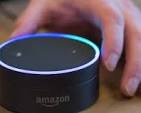
Yes, Amazon Alexa (and the devices it powers, like Echo speakers) is a quintessential Internet of Things (IoT) device because it’s a physical object that connects to the internet, uses sensors (microphones) to gather data, and can control other smart devices, acting as a central hub for a connected home. It embodies IoT by bridging the physical world with digital services through voice commands.
How Alexa fits the IoT definition:
- Connectivity: Alexa devices connect to your home Wi-Fi network to access the internet and cloud services.
- Data Collection: It uses microphones (sensors) to “hear” commands and requests, collecting audio data.
- Control & Automation: It sends commands over the internet to control other IoT devices like smart lights, thermostats, and locks.
- Physical Object: The Amazon Echo speaker is a tangible, non-standard computing device that’s part of the “Internet of Things”.
- Cloud-Based: The “brain” of Alexa runs in the cloud, allowing it to process complex requests and integrate with numerous third-party services and devices.
In essence, Alexa is a voice-enabled interface for a vast IoT ecosystem, making it easy for users to manage their connected home with simple voice commands.
What are the 7 layers of IoT?
7 Layers of Internet of Things | What Makes an IoT Solution Comprehensive?
- 1) Sensors
- 2) Sensors to Gateway Network
- 3) Gateways
- 4) Gateways to Internet Network
- 5) Data Ingestion and Information Processing
- 6) Internet to User Network
- 7) Value-added Information
What is the IoT salary?
IoT salaries vary widely by experience, location, and company, but generally range from around ₹3-7 Lakhs/year for freshers (e.g., ₹3.2-4.7L in India) to ₹10-20+ Lakhs/year for experienced professionals (e.g., ₹16-20L+ for 10+ years in India), with senior roles and major tech hubs like Bangalore seeing averages well into the ₹20-28 Lakhs/year bracket. Key factors are your specific skills (hardware, software, embedded), role (engineer, developer, architect), and the company’s pay scale, with top firms offering significantly higher packages.
By Experience Level (India Example):
- Fresher (0-1 year): ₹3 – ₹5 Lakhs/year (₹25k-₹41k/month)
- Mid-Level (3-6 years): ₹7.6 – ₹8.4 Lakhs/year (₹75k-₹91k/month)
- Senior (9+ years): ₹10.7 – ₹18 Lakhs+/year (₹1L-₹1.5L+/month)
By Location (India Example):
- Bangalore: Higher averages, potentially ₹28 Lakhs/year (₹27.5L average) for experienced roles,.
- Other Cities: Salaries scale down, e.g., Chennai (₹4.4-5.6L), Hyderabad (₹3.9-4.9L) for engineers.
By Role & Company:
- IoT Engineer: Ranges broadly from entry-level to senior positions.
- Senior IoT Engineer: Higher compensation due to complexity.
- Top Companies: May pay significantly more; some roles reaching ₹20-29 Lakhs/year.
Key Factors Influencing Salary:
- Experience: The biggest driver of salary growth.
- Location: Major tech hubs pay more.
- Skills: Specialization (embedded, cloud, security) matters.
- Company: Large tech companies generally pay more than smaller firms.
What are the disadvantages of IoT devices?
The Internet of Things (IoT) has several disadvantages, including:
- Security Risks: IoT devices often have weak security measures, making them vulnerable to hacking, data breaches, and unauthorized access. …
- Privacy Concerns: IoT devices collect vast amounts of personal data, which can be misused if not properly secured.