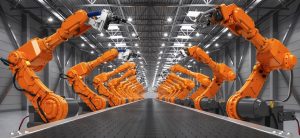


The “work volume” generated by robotics and automation has two primary meanings: the physical 3D space an industrial robot can reach and the economic and operational volume of work they create or transform. A robot’s physical work volume is determined by its physical configuration, such as its joint limits and arm length, and can range from simple rectangular shapes to irregular shapes for articulated robots. The economic and operational volume refers to how automation increases productivity, efficiency, and quality while shifting labor demands towards roles involving maintenance, programming, and data analysis.
Physical work volume:
- Definition: The 3D space within which a robot’s end-of-wrist (end effector) can operate.
- Factors influencing size and shape:
- Robot configuration: Different types of robots, like Cartesian or articulated arm robots, have different work volume shapes.
- Joint limits: The range of motion for each joint restricts the robot’s reach.
- Arm length and body size: The physical dimensions of the robot’s arm and base determine the overall size of the work volume.
- Precision: The robot’s ability to operate accurately and repeatably within this volume is determined by its control system and mechanical design.
Economic and operational volume:
- Increased productivity: Robots can perform tasks faster, continuously, and without fatigue, leading to a significant increase in output.
- Improved quality and consistency: Robots provide high repeatability and accuracy, resulting in more consistent and higher-quality products.
- Shift in labor: Automation can displace some jobs, but it also creates new ones. The operational volume shifts to tasks involving robot maintenance, programming, and data analysis needed to manage the automated systems.
- Expanded capabilities: Automation allows for work in hazardous environments and the processing of complex data, expanding the types of jobs that can be performed.
- Market growth: The global robotics and automation market is projected to grow substantially, indicating a massive increase in the adoption and scope of these technologies across various industries, such as automotive, manufacturing, and healthcare.
What is work volume in robotics?
Work volume (also called the workspace or envelope) is the 3D space within which a robot can operate. The shape and size of the work volume depend on the robot’s configuration, joint limits, and arm length.
What are the statistics of robotics and automation?
According to the latest robotics statistics from the International Federation of Robotics (IFR), around 4.3 million robots operated in factories around the world as of 2023 – a 10% increase from the previous year. Annual robotic installations also exceeded 500,000 in 2024 for the third consecutive year.
What percentage of jobs have been taken by robots?
Many of the earlier studies in this field left job creation out of the equation. New studies have shown that, in fact, net job loss from technological deployment is about 1%. This includes our own research at LSE, and is supported by research at McKinsey & Company, PricewaterhouseCoopers, and the World Economic Forum.
How many robots per 10,000 employees?
Frankfurt, Nov 20, 2024 — Robot adoption in factories around the world continues at high speed: The new global average robot density reaches a record 162 units per 10,000 employees in 2023 – more than double the number measured only seven years ago (74 units). As per a report published in Nov. 2024.
What are the 4 D’s of robotics?
The “4 D’s of robotics” is a principle that identifies tasks suitable for automation: Dull (repetitive), Dirty (unhygienic), Dangerous (risk of harm), and Dear (costly or critical). Robots are used to perform these jobs because they can do them consistently without risk to human safety or the high cost of human error, such as in manufacturing, waste management, or mine exploration.
Which country is no. 1 in robotics?
Japan is considered #1 in robotics because it is the world’s predominant industrial robot manufacturer, producing 45% of the global supply. Other countries leading in robotics include China and South Korea, which are strong in terms of new installations and robot density, respectively.
Japan >>
- Manufacturing dominance: Japan produces nearly half of the world’s industrial robots and has a high export ratio, according to the International Federation of Robotics.
- Robot density: It has a high density of robots, with 390 robots per 10,000 employees, as of 2020 data from The Robot Report.
- Market size: The domestic Japanese robot market is the second-largest in the world, behind China, notes the International Federation of Robotics.
Other leading countries >>
- China: Leads in the number of new robot installations, accounting for 50% of the global total in 2022.
- South Korea: Ranks first in the number of robots per GDP and is one of the leading nations in terms of robot installations, as reported by the World Intellectual Property Organization (WIPO) and International Federation of Robotics (IFR).
- Germany: Is the largest robot market in Europe and has a high robot density, particularly in its automotive industry.
- Singapore: Is also highlighted by the International Federation of Robotics (IFR) and World Intellectual Property Organization (WIPO) as a country with high robot density relative to its GDP.
What are the 4 types of automation?
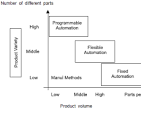
The four main types of automation are fixed, programmable, flexible, and integrated, according to Universal Technical Institute, South Shore Controls, and Amplework. Fixed automation is for high-volume, fixed production, while programmable automation can be changed for different tasks. Flexible automation allows for quick changeovers and integrated automation connects multiple systems with data to control the entire factory.
1. Fixed automation
- Description: Designed for producing a single, high-volume product with little to no flexibility. It uses equipment configured for one specific task.
- Best for: Manufacturing processes that do not change frequently, where the primary goal is efficiency and speed.
2. Programmable automation
- Description: Features equipment that can be reprogrammed to perform different tasks or produce different products. Production is often done in batches.
- Best for: Industries that produce a variety of products but in a sequential manner, requiring changes to the automation program for each new batch.
3. Flexible automation
- Description: A more advanced version of programmable automation, using computer-controlled systems to enable rapid changeovers between different products.
- Best for: Manufacturing environments that need to produce a wide variety of products with minimal setup time between runs.
4. Integrated automation
- Description: A system where all production stages and processes are linked together and controlled by data. It allows for seamless flow of information and control across the entire operation.
- Best for: Creating a “smart factory” where all machines and systems communicate with each other to optimize overall production.
We hope that the above article helps.