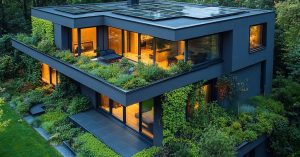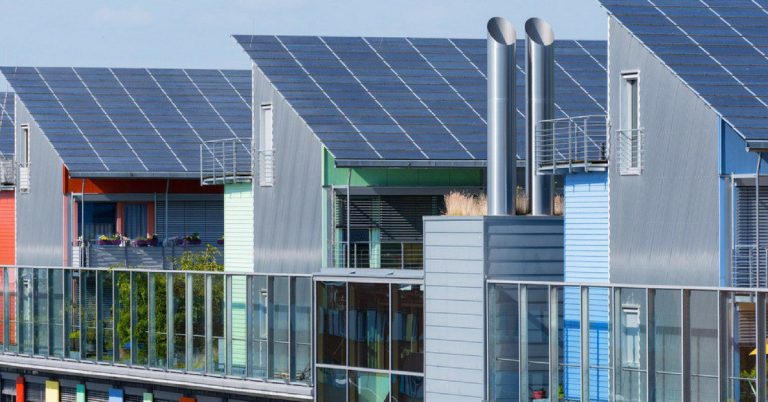


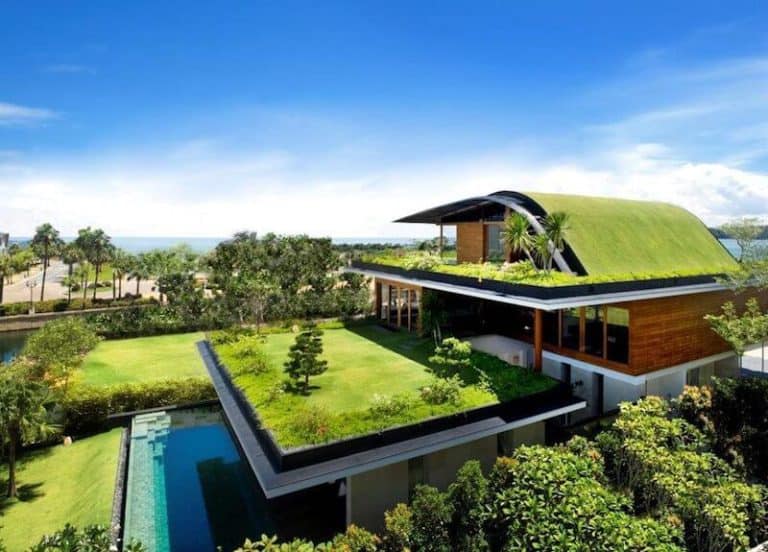
A modern house based on green technology integrates sustainable materials, renewable energy systems, and intelligent automation to minimize environmental impact, reduce operating costs, and enhance occupant health. These homes are designed with a holistic, long-term approach, often targeting net-zero or net-positive energy consumption.
Here are the key components and technologies defining a modern green home:
1. Sustainable & High-Performance Materials:
- Locally Sourced & Recycled Materials: Use of reclaimed wood, recycled steel, and recycled concrete aggregate to reduce embodied energy.
- Eco-Friendly Structural Elements: Compressed Stabilized Earth Blocks (CSEB), fly ash bricks, and bamboo are used for durability and lower carbon footprint.
- Advanced Insulation: Sheep’s wool or cellulose (recycled paper) insulation, which is non-toxic, reduces energy consumption by 10–20%.
- Non-Toxic Finishes: Low-VOC (Volatile Organic Compounds) paints and finishes improve indoor air quality.
2. Renewable Energy & Efficiency (Active & Passive):
- Net-Zero Solar Technology: Rooftop solar photovoltaic (PV) panels and solar tiles generate clean electricity, with battery storage solutions allowing for off-grid capabilities.
- Passive Design: Strategic orientation (often north-south), large, high-performance windows, and skylights maximize natural light and heating.
- Thermal Mass & Natural Cooling: Exposed brick, rammed earth, or stone walls regulate temperature, while green roofs and living walls provide insulation and reduce the heat island effect.
- Geothermal Heating/Cooling: Utilizing the constant temperature of the earth to heat and cool, reducing HVAC energy consumption by 30–40%.
- Mechanical Ventilation with Heat Recovery (MVHR): Ensures fresh air circulation while retaining heat from outgoing air.
3. Smart Water Management:
- Rainwater Harvesting: Collecting rainwater from roofs for landscape irrigation or household use.
- Greywater Recycling: Systems that treat water from showers and sinks for reuse in toilets or irrigation.
- Low-Flow Fixtures: Smart faucet, showerhead, and dual-flush toilet technologies minimize water usage.
4. Smart Technology (IoT) & Automation:
- Smart Energy Management: IoT-enabled systems monitor real-time energy consumption, automatically managing lighting and appliances to minimize waste.
- Smart Thermostats: Devices like Nest or Ecobee learn occupancy patterns and adjust heating/cooling for maximum efficiency.
- Automated Lighting & Blinds: Motion sensors and automated shading reduce energy usage based on presence and daylight levels.
Real-World Examples:
- The Edge (Amsterdam): Known as one of the world’s greenest buildings, it uses a digital ceiling with Ethernet-powered LED lighting and an aquifer thermal energy storage system.
- Bullitt Center (Seattle): A 6-story building designed to be net-zero energy, using composting toilets and 100% renewable on-site energy.
- Villa Prakriti (India): A 4,500 sq ft farmhouse in Igatpuri that acts as a net-zero residence, utilizing passive cooling, solar panels, and biogas for cooking.
- Holmberg House (Argentina): Features a unique “perimetral integral skin” water circulation system that uses solar-powered thermopanels for natural heating and cooling.
By combining these technologies, modern green homes achieve up to 25–40% energy savings, lower utility bills, and higher property values.
What is green home technology?
Technology plays a pivotal role in making green homes more efficient and convenient. Smart energy systems allow homeowners to monitor and control energy usage in real time, ensuring minimal wastage. Smart Thermostats: Devices like Nest and Ecobee optimize heating and cooling based on occupancy and weather patterns.
What is the most eco-friendly house?
Types of eco-friendly houses >>
- Prefabricated homes. Prefabricated homes take only a fraction of the time to build compared to traditionally built homes, think just a couple of weeks compared to months or even years! …
- Tiny houses. …
- Zero-carbon homes. …
- Passive houses. …
- Shipping container homes.
What are the green technologies for building?
A: The main features of a green building include energy-efficient systems, sustainable materials, improved indoor air quality, water-saving technologies, and renewable energy integration. These features help reduce environmental impact and support compliance with green standards.
How can I use green tech at home?
Green Tech at Home: Simple Gadgets for a Smarter, Cleaner…
- Why Green Tech at Home Matters.
- ☀️ Solar Lamps: Clean Energy, Everyday Convenience.
- 💡 Energy-Efficient Bulbs: Small Change, Big Savings.
- 🚿 Water-Saving Devices: Conserving a Precious Resource.
- 🔌 Smart Power Strips: Cutting Invisible Energy Waste.
What are 5 types of green technology in India?
India is adopting various green technologies, with key types including Renewable Energy (solar, wind), Sustainable Water Management (rainwater harvesting, solar desalination), Waste-to-Value (plastic roads, e-waste recycling), Electric Mobility, and Sustainable Agriculture (urban farming, improved irrigation) to tackle environmental challenges and promote sustainability.
Here are five types of green technology prominent in India:
- Renewable Energy Generation: Large-scale solar power plants and rooftop solar installations are common, along with increasing wind energy projects, reducing reliance on fossil fuels.
- Water Management & Conservation: Technologies like traditional rainwater harvesting (Kundi) and modern IoT-based smart systems are used, alongside solar-powered desalination for coastal areas facing water scarcity.
- Waste-to-Value Technologies: A significant innovation is the use of waste plastic in building roads (plastic roads), improving durability while addressing plastic pollution, alongside e-waste recycling and waste-to-energy.
- Electric Mobility (EVs): India is promoting electric vehicles and charging infrastructure to reduce vehicular emissions, a crucial step for cleaner urban transport.
- Sustainable Agriculture & Urban Greening: This includes precision farming, smart irrigation to conserve water, and urban greening efforts like green walls and vertical farming to improve food security and urban environments.
What are the 4 types of greenhouses?
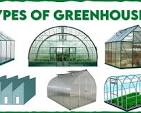
The four main types of greenhouses, categorized by shape and structure, are Lean-to, Even-span, Quonset (Hoop House), and Gothic Arch, with others like A-Frame also common, offering different levels of cost, space, and ventilation for various growing needs. Lean-to attaches to a building, Even-span is a classic freestanding gable, Quonset uses curved hoops for affordability, and Gothic Arch offers steep, pointed roofs for better snow/ventilation.
Here’s a breakdown of these common types:
- Lean-to: Built against an existing structure (like a house or shed) using it as one wall, saving space and materials, ideal for smaller gardens but limited in width.
- Even-span: A traditional, freestanding structure with two equal roof slopes, offering good growing space, but can be more complex to build.
- Quonset (Hoop House): Simple, semi-circular structures made from bent pipes (PVC or metal) covered with plastic film, making them inexpensive and easy to erect for basic needs.
- Gothic Arch: Features a pointed, arching roof, providing excellent headroom and efficient shedding of rain and snow, similar to cathedral architecture, notes The Knowledge Academy.
Other popular types include:
- A-Frame: Resembles the letter ‘A’, good for shedding precipitation.
- Sawtooth: Series of gable roofs with vertical panels for ventilation, suited for hot climates.
- Ridge and Furrow (Gutter-Connected): Multiple even-span sections linked by gutters, used for large-scale commercial operations.
What are the 7 components of a green building?
The 7 core components of a green building focus on minimizing environmental impact and occupant health, typically encompassing Energy Efficiency, Water Conservation, Sustainable Materials, Indoor Environmental Quality, Waste Reduction, Smart Site Design, and Innovation/Resilience, covering everything from site selection and material sourcing to energy use and long-term performance.
Here’s a breakdown of these key areas:
- Energy Efficiency & Renewables: Using passive design, smart insulation, efficient HVAC, and renewable sources like solar power to reduce energy consumption.
- Water Conservation: Implementing low-flow fixtures, rainwater harvesting, greywater systems, and water-wise landscaping (xeriscaping).
- Sustainable Materials: Choosing recycled, renewable, locally sourced, and low-toxicity materials (like bamboo, recycled steel, non-VOC paints).
- Indoor Environmental Quality (IEQ): Maximizing natural light, providing fresh air ventilation, and using non-toxic finishes for occupant health and productivity.
- Waste Reduction: Minimizing construction and demolition waste through recycling, reuse, and designing for durability.
- Sustainable Site Design: Choosing appropriate sites, preserving natural features, reducing heat island effects (green roofs), and promoting walkability.
- Innovation & Resilience: Integrating smart technology (IoT) for performance monitoring, designing for adaptability, and ensuring long-term durability and climate resilience.
What are the 4 types of sustainability?
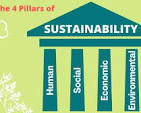
The four types (or pillars) of sustainability are Environmental, Social, Economic, and Cultural, forming a holistic approach to development that balances planet, people, profit, and heritage for long-term well-being. Environmental focuses on nature, Social on communities, Economic on financial stability, and Cultural on preserving traditions and diversity, all interconnected for true sustainable progress.
The Four Pillars of Sustainability:
- Environmental Sustainability: Preserving natural resources and ecosystems, focusing on clean air, water, biodiversity, and reducing pollution to ensure the planet’s long-term health.
- Social Sustainability: Promoting equity, well-being, and strong communities, including fair wages, education, healthcare, and social justice for all.
- Economic Sustainability: Fostering long-term financial viability and growth that supports communities and minimizes negative impacts, balancing profit with social and environmental responsibility.
- Cultural Sustainability: Protecting and valuing diverse cultures, heritage, traditions, and arts, ensuring vibrant, tolerant, and respectful societies.
Why They Matter >>
These pillars work together; neglecting one can undermine the others, creating a comprehensive framework for sustainable development that addresses the needs of present and future generations.
If you are planning to build a house this year then you can click this reference link: https://www.google.com/search?q=Modern+House+based+on+Green+Technology&rlz=1C1CHBD_en-GBIN1169IN1169&oq=Modern+House+based+on+Green+Technology&gs_lcrp=EgZjaHJvbWUyBggAEEUYOTIHCAEQABjvBTIKCAIQABiABBiiBDIHCAMQABjvBTIKCAQQABiABBiiBDIKCAUQABiABBiiBNIBCTIxOTk4ajBqN6gCCLACAfEFW1xs897744k&sourceid=chrome&ie=UTF-8