

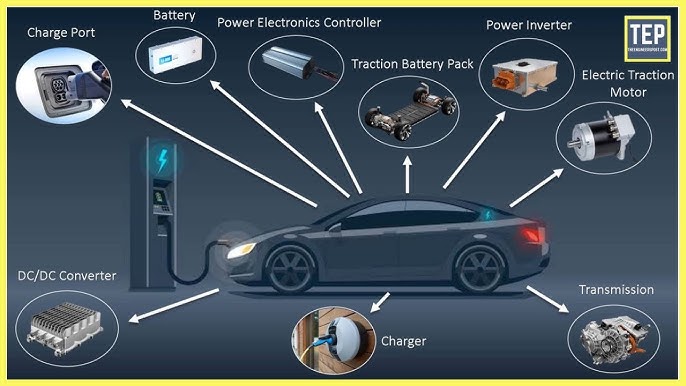
An electric vehicle (EV) is a car powered by one or more electric motors instead of an internal combustion engine, using energy stored in rechargeable batteries that are charged from an external power source. EVs produce zero tailpipe emissions, are quieter, and have lower running costs compared to traditional gas-powered cars.
Key Components and Features:
- Battery Pack: Stores electricity to power the motor.
A battery pack is an assembled group of identical battery cells or modules connected in series, parallel, or a combination of both to achieve a specific voltage, capacity, or power density. It includes a protective enclosure, a battery management system (BMS), and often cooling systems, powering devices like EVs, tools, and electronics.
Key Components of a Battery Pack
- Cells: Individual units (e.g., lithium-ion cells) that store energy.
- Battery Management System (BMS): Manages safety by monitoring voltage, temperature, and current to prevent overcharging or overheating.
- Interconnects: Conductive metal strips (busbars) that connect cells in series (to increase voltage) or parallel (to increase capacity).
- Enclosure/Case: Protects the cells from physical damage and environmental factors.
- Thermal Management: Systems (active or passive) to maintain optimal temperature.
Types of Battery Packs
- Portable/Consumer: Used in laptops, cameras, and power banks (e.g., Anker, mophie products), often focusing on compact design and durability.
- Industrial/EV: Large, complex systems designed for electric vehicles, energy storage systems, or heavy machinery, designed for high power output.
Advantages
Battery packs allow for customized power solutions to fit specific, often oddly shaped, spaces within devices while maximizing energy efficiency.
- Electric Motor: Converts electricity into motion to drive the wheels.
An electric motor is an electromechanical device that converts electrical energy into mechanical energy, typically creating rotational motion. It operates based on electromagnetism, where an electric current passing through a coil within a magnetic field produces a force (Lorentz force) that turns a shaft.
Key Aspects of Electric Motors:
- Principle of Operation: Motors work on the principle that a current-carrying conductor placed in a magnetic field experiences a force, often explained by Fleming’s left-hand rule.
- Main Components:
- Stator: The stationary part that produces a magnetic field (permanent magnet or electromagnet).
- Rotor (Armature): The rotating part that carries current and experiences force.
- Commutator/Brushes: In DC motors, these reverse current direction every half-turn to keep the motor spinning in one direction.
- Types of Motors:
- AC Motors: Driven by alternating current, commonly used in household appliances (fans, washing machines) and industrial machinery.
- DC Motors: Driven by direct current, used in applications requiring speed control, such as electric vehicles and power tools.
- Applications: They are widely used in fans, pumps, household appliances, industrial machinery, and transportation (electric cars, trains).
Essentially, an electric motor provides the rotational motion for numerous modern devices, converting power into useful work.
- No Tailpipe/Engine: There is no gasoline engine, fuel tank, or exhaust pipe.
“No Tailpipe/Engine” refers to vehicles, primarily battery electric vehicles (BEVs), that lack an internal combustion engine and an exhaust system, resulting in zero tailpipe emissions. While they eliminate exhaust pollutants, they still produce “non-tailpipe emissions” from brake wear, tire wear, and road dust resuspension.
Key Aspects of No Tailpipe/Engine Vehicles:
- Zero Tailpipe Emissions: Because there is no fuel combustion, these vehicles do not emit carbon dioxide (
), nitrogen oxides (
), or particulate matter (PM) from an exhaust pipe.
- Alternative Powertrain: Instead of an engine, these vehicles use electric motors and battery packs to generate power.
- Non-Tailpipe Emissions (NEE): While they lack exhaust, they still generate environmental impacts through particles released from tires, brake pads, and road surface abrasion.
- Environmental Impact: These vehicles are crucial for reducing greenhouse gas emissions and improving urban air quality. However, some research suggests that because electric vehicles are often heavier, their tire and road wear emissions might not be lower than those of conventional vehicles.
Significance:
The shift to “no tailpipe” technology is a critical strategy for tackling climate change and reducing air pollution, particularly as cities implement stricter emission regulations.
- Charging: Batteries are charged by plugging into home or public charging stations.
“Charging” refers to several actions: supplying electrical energy to a device or battery, asking a price for services or goods, or moving forward quickly, often to attack. It can also mean accusing someone of a crime, as in a formal accusation, or attributing responsibility for a fault.
Key Usage Examples:
- Electrical: “He is charging his smartphone using a USB cable”.
- Monetary: “The cafe is charging extra for soy milk”.
- Physical Attack/Movement: “The rugby player came charging through the defense”.
- Accusation/Legal: “The police are charging him with theft”.
Synonyms:
- Electrical/Fill: Powering, energizing, replenishing.
- Financial: Billing, demanding, setting a price, taxing.
- Attack/Rush: Rushing, rushing at, assaulting, attacking, storming.
- Accuse: Accusing, indicting, prosecuting, alleging.
- Regenerative Braking: The motor acts as a generator, slowing the car and storing energy back in the battery.
Regenerative braking is an energy recovery mechanism used in electric and hybrid vehicles that converts kinetic energy from braking into electricity, rather than wasting it as heat. By reversing the electric motor to act as a generator, the system slows the car down while charging the high-voltage battery, increasing efficiency and extending driving range. Tires Plus +3
Key Features and Benefits:
- Energy Capture: It can recapture up to 70% of energy that would otherwise be lost during braking.
- Reduced Wear: It reduces dependency on traditional hydraulic brakes, resulting in less wear on brake pads and rotors.
- Improved Efficiency: It allows for one-pedal driving, where lifting off the accelerator slows the vehicle and recharges the battery simultaneously.
- Operation: While it works at most speeds, it is less effective at very low speeds, where traditional friction brakes take over for a complete stop.
Regenerative braking is standard on almost all modern electric vehicles (EVs) and hybrid vehicles, playing a crucial role in reducing maintenance costs and improving overall energy usage.
Types of Electric Vehicles:
- Battery Electric Vehicle (BEV): Fully electric, relying solely on batteries and electric motors.
- Plug-in Hybrid Electric Vehicle (PHEV): Features both an electric motor and an internal combustion engine, using electricity for short distances before switching to gas.
- Fuel Cell Electric Vehicle (FCEV): Uses hydrogen fuel cells to produce electricity on board.
Benefits and Considerations:
- Pros: Lower fuel costs (electricity vs. petrol/diesel), zero emissions, quiet operation, and less maintenance (no oil changes).
- Cons: Higher initial purchase price, limited driving range compared to gas cars, and longer refueling (charging) times.
What is considered an EV car?
An EV includes both a vehicle that can only be powered by an electric motor that draws electricity from a battery (EV) and a vehicle that can be powered by an electric motor that draws electricity from a battery and by an internal combustion engine (plug-in hybrid electric vehicle).
What does EVs mean on a car?
An EV (Electric Vehicle) is a car or vehicle powered by one or more electric motors, using energy stored in rechargeable batteries rather than a gasoline-powered engine. Unlike traditional cars, EVs run entirely on electricity, producing zero tailpipe emissions and requiring charging from an external power source.
Key Aspects of EVs:
- Battery Electric Vehicle (BEV): Fully electric with no gasoline engine.
- Power Source: Driven by electric motors and battery packs instead of an internal combustion engine.
- Charging: Recharged via home chargers or public charging stations.
- Benefits: Lower running costs, quiet operation, and zero tailpipe emissions.
- Types: While BEVs are pure electric, the term can sometimes be used broadly to include plug-in hybrids (PHEVs), which use both electricity and gas.
What is an EV and how does it work?
EV is an acronym for electric vehicle. What are EVs? They are cars with an electric motor powered by a battery instead of a combustion engine powered by gasoline. One of the reasons EVs have gained in popularity is improvements to newer battery technology.
Which is better, EV or hybrid?
Neither is strictly “better”; the choice depends on your driving habits, access to charging, and budget.
Hybrid cars are better for long-distance drivers, those lacking easy charging access, or those wanting lower upfront costs. Electric vehicles (EVs) are superior for city driving, lower operating costs, lower maintenance, and zero-emission goals. Mg motors +2
Hybrid Advantages
- No Range Anxiety: Uses gas for, convenience, removing the need to locate charging stations on long trips.
- Lower Upfront Cost: Generally cheaper to purchase than comparable EVs.
- Better for Longer Distances: Ideal if you cannot rely on charging infrastructure.
- Convenience: Fast refueling compared to waiting for a charge.
Electric Vehicle (EV) Advantages:
- Lower Running Costs: Charging is far cheaper than buying petrol.
- Zero Emissions: Better for the environment as they produce no tailpipe pollution.
- Lower Maintenance: No engine oil changes, spark plugs, or exhaust repairs, reducing long-term upkeep.
- Quiet & Smooth: Offers a superior, smooth driving experience.
Key Comparison Points:
- Best for Cities: EVs are better due to regenerative braking and short-range efficiency.
- Best for Road Trips: Hybrids provide more flexibility.
- Budget & Ownership: While Hybrids cost less upfront, EVs often save more over time due to lower fuel and maintenance costs.
In 2026, if you have consistent home charging, an EV is likely more cost-effective. If you live in an apartment or drive long distances frequently, a hybrid is often more practical.
Which is the largest selling EV car in India?
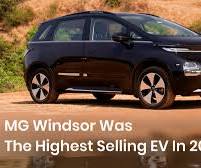
As of early 2026, the MG Windsor EV is the highest-selling electric car in India, having taken the top spot in 2025 with over 46,000 units sold and continuing its lead into January 2026. The Windsor outperformed established rivals like the Tata Nexon EV and Punch EV, driven by its unique “Battery-as-a-Service” (BaaS) model.
Top Selling EVs in India (2025–2026 Trends):
- MG Windsor EV: The market leader in 2025, praised for its spacious “crossover” design and affordable, subscription-based pricing.
- Tata Nexon EV: A top contender that long held the throne, remaining a highly popular SUV choice.
- Tata Punch EV: A popular, compact, and safe EV choice in the sub-₹15 lakh segment.
- MG Comet EV: A popular entry-level option for city driving.
- Tata Tiago EV: Often ranks high for being one of the most accessible electric hatchbacks.
Key factors driving these sales are competitive pricing (often under ₹15-18 lakhs for top models) and improved range, with many models offering over 300–400 km on a single charge.
What is the biggest problem with EV cars?
Electric Cars – What are the downsides to electric cars?
- Their batteries need rare metals
- Making electric cars creates more emissions
- They are only as green as their power sources
- Electric cars can be expensive to buy
- You can’t drive as far in an electric car
- There aren’t enough charging points
Which country is 100% EV?
Norway is the world leader in electric vehicle (EV) adoption, with over 96% of new car sales being electric as of August 2025. The country is on track to phase out new fossil fuel car sales entirely, driven by long-term policy incentives and a robust charging network. Other top countries include China (highest total volume) and Nordic neighbors.
Key 100% Electric Vehicle Leaders
- Norway: The undisputed leader, nearing 100% market share for new plugin vehicles (98.4% in Aug 2025).
- Targeting 100%: Several countries have targets, such as Canada aiming for 100% zero-emission vehicle sales by 2035.
Top EV Markets by Adoption (2024–2025 Data)
- China: Leads in total volume, with over 20 million EVs on the road and over 48% market share in 2024.
- Sweden & Denmark: Consistently high market shares (58% and 56% respectively).
- Finland & Netherlands: Both seeing roughly 50% or higher EV sales share.
- Germany: Leading European country in total registrations after China.
Key Drivers for High Adoption
- Financial Incentives: Tax breaks, reduced tolls, and free parking.
- Charging Infrastructure: Widespread availability, with the Netherlands, Germany, and France leading in public charging points.
- Stringent Policies: High emissions standards and penalties for ICE (internal combustion engine) vehicles.
So, if you are planning to buy an EV car the click this reference link to know more: https://www.google.com/search?q=What+are+EV+cars+%3F&rlz=1C1CHBD_en-GBIN1169IN1169&oq=What+are+EV+cars+%3F&gs_lcrp=EgZjaHJvbWUyBggAEEUYOTIICAEQABgWGB4yCAgCEAAYFhgeMggIAxAAGBYYHjIICAQQABgWGB4yCAgFEAAYFhgeMggIBhAAGBYYHjIICAcQABgWGB4yCAgIEAAYFhgeMggICRAAGBYYHtIBCDk3OTRqMGo3qAIIsAIB8QVFGOLFe9EOOQ&sourceid=chrome&ie=UTF-8