

Yes, blockchain technology is deeply related to data management by providing a decentralized, immutable, and transparent way to record and store information. Unlike traditional databases, blockchain ensures data integrity through distributed cryptographic ledger technology, enhancing security, reducing unauthorized access, and streamlining data sharing without intermediaries.
Key Data Management Benefits:
- Immutable Data Integrity: Data recorded in a blockchain cannot be modified or deleted, ensuring a permanent and untamperable audit trail.
- Decentralized Storage: Data is stored across a network of nodes rather than a single location, reducing risks of single points of failure.
- Enhanced Security: Information is secured using advanced cryptographic algorithms, providing superior security compared to traditional databases.
- Transparency and Trust: All participants in the network have access to the same synchronized, authorized data.
Typical Applications:
- Supply Chain: Real-time tracking and immutable records of asset journeys.
- Healthcare: Secure storage of electronic health records (EHR).
- Financial Services: Secure, instant verification of transactions and records.
Blockchain excels in scenarios where data trust and provenance are critical, although it is not typically used for storing large, high-volume, or sensitive datasets due to cost and public privacy issues.
Blockchain differs fundamentally from SQL/NoSQL databases by replacing centralized trust with decentralized, cryptographic verification. While SQL and NoSQL are designed for fast, mutable data storage managed by a single entity, blockchain serves as an immutable, distributed ledger used primarily for sharing trusted records among multiple parties who may not trust each other.
Here is a detailed comparison:
1. Architecture: Decentralization vs. Centralization:
- Blockchain: Decentralized and distributed. Data is replicated across numerous independent nodes. There is no central administrator, preventing a single point of failure or manipulation.
- SQL/NoSQL: Centralized. A central administrator (or organization) has absolute control, making CRUD (Create, Read, Update, Delete) operations highly efficient.
2. Data Integrity: Immutability vs. Mutability:
- Blockchain: Append-only and immutable. Once data is added to a block and confirmed by the network, it cannot be modified or deleted, creating a permanent audit trail.
- SQL/NoSQL: Mutable. Records can be seamlessly updated, rewritten, or erased by authorized users.
3. Performance and Scalability:
- Blockchain: Slower, with higher latency due to the need for consensus protocols (e.g., Proof of Work, Proof of Stake) among nodes to verify transactions.
- SQL/NoSQL: Highly efficient, capable of processing thousands or millions of transactions per second (TPS) due to the absence of network-wide consensus.
4. Trust and Transparency:
- Blockchain: Trustless. Security is derived from consensus mechanisms rather than permissions, ideal for environments with distrusting parties.
- SQL/NoSQL: Trusted. Security relies on administrative permission and the security of the server.
5. Cost Structure:
- Blockchain: Expensive. Because every node stores a copy of the ledger, the total cost of storage and computation is much higher (redundancy cost).
- SQL/NoSQL: Cheaper. Data is stored centrally, reducing costs for high-volume data management.
Comparison Summary Table:
| Feature | Blockchain | SQL Database | NoSQL Database |
|---|---|---|---|
| Structure | Decentralized, Distributed | Centralized, Structured | Centralized/Distributed, Flexible |
| Data Integrity | Immutable (Write-only) | Mutable | Mutable |
| Speed/Perf | Slow (High latency) | Very Fast | Fast to Very Fast |
| Scalability | Complex (Layer 2) | Vertical (Upgrades) | Horizontal (Sharding) |
| Primary Goal | Trustless, Shared Record | Data Consistency/Complex Queries | Data Flexibility/Scale |
| Examples | Ethereum, Bitcoin | MySQL, PostgreSQL | MongoDB, Cassandra |
When to Use Which?
- Use Blockchain: If you need a tamper-proof, immutable audit trail, shared record-keeping between distrusting parties, or tokenized digital assets.
- Use SQL: When data integrity is paramount, ACID transactions are required, and structured data with complex relationships exists.
- Use NoSQL: When high performance and horizontal scaling are needed for unstructured or rapidly changing data.
Most enterprise applications now use a hybrid approach: storing operational data in NoSQL/SQL databases for speed and sensitive, finalized data on a blockchain for trust and verification.
Triple-entry accounting is an enhancement of traditional double-entry bookkeeping that uses blockchain technology to create a cryptographically sealed, immutable third record of transactions between two parties. It adds a secure “shared ledger” that acts as an unbiased, permanent, and audit-friendly record of inter-company transactions.
Core Components of Triple Entry Accounting:
- Double Entry Base: Transactions still follow the traditional debit/credit structure, but in a shared format.
- The Third Entry: A digitally signed, encrypted receipt generated during a transaction. This receipt is automatically added to a shared, public, or decentralized ledger (like blockchain).
- Real-time Recording: Transactions are instantly recorded on the shared ledger, ensuring a high level of transparency.
Key Advantages:
- Enhanced Security & Reduced Fraud: Cryptographic sealing makes it nearly impossible to alter or destroy records.
- Automatic Reconciliation: Because both parties share the same immutable record (the third entry), the need for time-consuming reconciliation is greatly reduced.
- Improved Auditability: Auditors can use the third entry to verify the legitimacy of records, which serves as a “shared record of truth”.
- Transparency: It provides a trusted, verifiable audit trail for B2B transactions.
Origins and Implementation:
- Proposed by Yuji Ijiri (1986): The concept was originally proposed as an expansion of traditional accounting theories.
- Blockchain Integration: The development of distributed ledger technology has provided the mechanism to turn the theory into practice.
How It Works (Example)>>
When a transaction occurs between Party A and Party B:
- Party A records a debit.
- Party B records a credit.
- The Blockchain records a digitally signed, timestamped, and immutable record of the transaction.
This method reduces trust issues between companies as it allows for an objective, auditable trail of events.
Blockchain technology, by design, has significant storage limitations compared to traditional centralized databases. Because of its immutable, append-only nature, every full node in a decentralized network must store the entire history of transactions, causing the ledger to grow indefinitely.
Here is a detailed breakdown of the storage limits and challenges of blockchain:
1. Inherent Storage Constraints:
- Indefinite Growth & Redundancy: Data can only be added, never deleted, leading to a continuously expanding ledger. Because every full node must maintain a complete copy of the ledger, storage requirements are multiplied by the number of nodes, making it inefficient for storing large amounts of data.
- State Bloat: As the chain grows, full nodes need more storage and bandwidth, which can make it hard for new nodes to synchronize with the network.
- High Cost: Storing data directly on popular blockchains is impractical for large files. For example, as of February 2022, it cost approximately $20,000 to store just 500KB on Ethereum.
2. Specific Blockchain Examples:
- Bitcoin: As of late 2022, the Bitcoin blockchain exceeded 440 GB of data. Bitcoin records only 3–4 transactions per second (TPS), with a block size limit (1MB, though often higher with SegWit) that acts as a secure constraint to prevent network overload.
- Ethereum: The Ethereum blockchain size reached over 1 TB (and over 1.4 TB by 2025), with substantial storage demands driven by smart contracts and dApps.
- Specialized Storage Chains: Other blockchains like Arweave, Filecoin, Storj, and Sia are designed for storage, with capacities in the petabytes. Arweave, for instance, allows for permanent, one-time-fee storage of any size, whereas Filecoin supports files up to 64GiB.
3. Key Reasons for Storage Limits:
- Decentralization & Security: Limiting the amount of data ensures that regular users can still run full nodes, which is crucial for decentralized security. If storage requirements were too high, only centralized entities could run nodes.
- DoS Attack Protection: Smaller block limits help prevent attackers from overwhelming the network with massive, complex data, which could cause a denial-of-service (DoS) attack.
- Node Synchronization: Smaller data sizes ensure that nodes can quickly synchronize, even if they have been offline, and keep up with the current “tip” of the chain.
Vitalik Buterin’s website +3
4. Solutions and Workarounds:
- Off-Chain Data Storage (IPFS): The most common solution is to store large files on a decentralized file system like IPFS (InterPlanetary File System) and only store the cryptographic hash of the data on the blockchain.
- Data Pruning: Nodes can discard older historical data that is not needed for immediate validation, keeping only the most recent part of the ledger.
- Sharding: Sharding partitions the blockchain into smaller, more manageable pieces (shards), allowing nodes to process only a subset of data rather than the whole history.
- Layer-2 Solutions: Using L2 solutions, such as rollups, allows transactions to be processed off-chain, with only summarized data posted to the L1 (e.g., Ethereum), saving space.
In summary, blockchains are designed to provide proof of ownership, transparency, and immutability, not to act as general-purpose, massive data warehouses.
What is blockchain data management?
In blockchain technology, each transaction is grouped into blocks, which are then linked together, forming a secure and transparent chain. This structure guarantees data integrity and provides a tamper-proof record, making blockchain ideal for applications like cryptocurrencies and supply chain management.
What are the 4 types of blockchain technology?
AI Overview
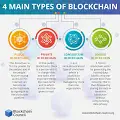
The four main types of blockchain networks are public, private, consortium, and hybrid, classified by their access control (permissionless vs. permissioned) and governance structure. They range from fully decentralized (public) to highly restricted (private) systems tailored for specific enterprise, financial, or public use cases. CENTRE OF EXCELLENCE IN BLOCKCHAIN TECHNOLOGY +1
- Public Blockchain: Completely open, decentralized, and permissionless networks (e.g., Bitcoin, Ethereum) where anyone can join, validate transactions, and view the ledger.
- Private Blockchain: Restricted, centralized, permissioned networks controlled by a single organization, ideal for internal business operations and high privacy needs (e.g., Hyperledger).
- Consortium Blockchain (Federated): Semi-decentralized networks managed by a group of organizations rather than one, often used for inter-bank transactions or supply chains to maintain control while collaborating.
- Hybrid Blockchain: A combination of private and public networks, allowing companies to set up private, restricted systems alongside public, open-source ones, providing both privacy and secure public communication.
CENTRE OF EXCELLENCE IN BLOCKCHAIN TECHNOLOGY +6
Key Differences at a Glance
| Type | Access | Control | Typical Use Cases |
|---|---|---|---|
| Public | Open to all | Decentralized | Crypto, DeFi, NFTs |
| Private | Restricted | Single entity | Internal audit, supply chain |
| Consortium | Limited (Group) | Shared Control | Banking, consortium supply chain |
| Hybrid | Mixed | Mixed | Medical, Government, Real Estate |
To know more just click the reference link: https://www.google.com/search?q=is+Blockchain+Technology+related+to+Data+Management%3F&rlz=1C1CHBD_en-GBIN1169IN1169&oq=is+Blockchain+Technology+related+to+Data+Management%3F&gs_lcrp=EgZjaHJvbWUyBggAEEUYOTIHCAEQIRigATIHCAIQIRigATIHCAMQIRiPAjIHCAQQIRiPAtIBCTIzNTE4ajBqN6gCCLACAfEFViF1fQ7VtSs&sourceid=chrome&ie=UTF-8