

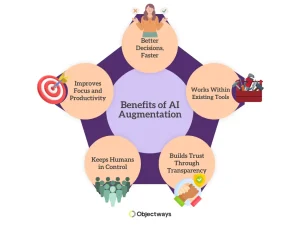
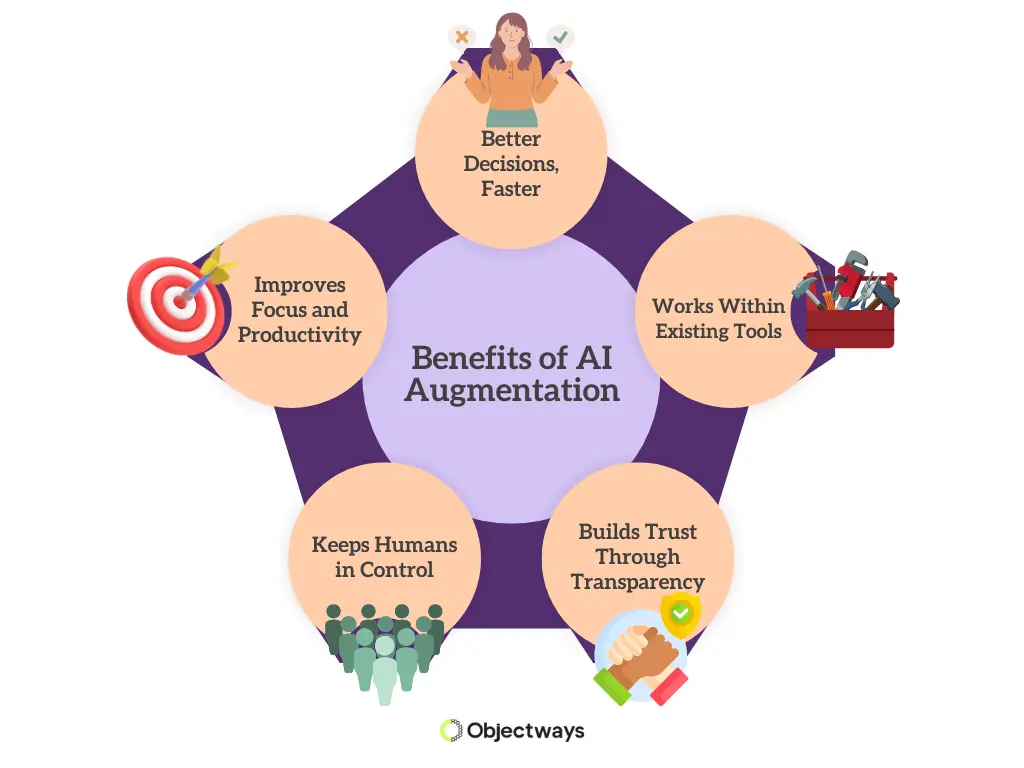
AI augmentation (or augmented intelligence) is the use of AI technologies to enhance, rather than replace, human cognitive functions, decision-making, and productivity. It functions as a “co-pilot” or support system, with AI handling data-heavy, repetitive, or analytical tasks while humans provide context, creativity, and judgment.
Key Aspects and Examples of AI Augmentation:
- Enhanced Decision-Making: Using AI for predictive analytics, such as forecasting demand in logistics or identifying patterns, which humans then use to make final decisions.
Enhanced decision-making AI leverages machine learning, data analytics, and automation to analyze massive datasets, identify patterns, and provide actionable insights, accelerating and improving accuracy for businesses. Rather than replacing humans, these systems augment judgment, increasing efficiency and consistency across sectors like finance, healthcare, and manufacturing. Key tools include predictive analytics for future scenarios, real-time monitoring for risk, and automated workflows.
Key Aspects of AI-Enhanced Decision Making:
- Data-Driven Insights: AI processes information beyond human capability, identifying subtle correlations to inform strategic choices.
- Speed & Accuracy: Automated systems allow for rapid, data-driven decisions that are more consistent and less prone to human bias.
- Risk Management: AI is critical for detecting fraud in finance, assessing risks, and ensuring compliance with regulations.
- Operational Efficiency: Technologies optimize processes, such as predictive maintenance in manufacturing or supply chain optimization, which minimizes costs.
- Explainable AI (XAI): A crucial area focused on understanding how AI arrives at decisions to enhance trust and effectiveness.
Industry Applications:
- Finance/Banking: Real-time fraud detection and automated credit risk assessments.
- Healthcare: AI analyzes medical imagery and patient data to assist in diagnosing conditions like cancer or sepsis.
- Manufacturing: Real-time monitoring of machinery to predict maintenance needs, reducing downtime.
- Human Resources: AI tools aid in resume screening and predicting employee turnover
- Creative Support: Tools like Adobe Photoshop or generative AI, which help designers iterate on ideas faster.
AI-powered creative support acts as a collaborative partner to enhance human creativity by accelerating workflows, brainstorming, and refining concepts, rather than replacing the artist. It serves as a tool for generating ideas, automating repetitive tasks, and providing new perspectives.
Here are the key ways AI supports the creative process:
- Brainstorming & Idea Generation: AI acts as a “sparring partner,” offering diverse concepts, metaphors, or unexpected connections to overcome creative blocks. Tools like ChatGPT or Claude can draft content, create storyboards, or produce initial drafts.
- Visual Exploration & Editing: Generative AI allows for rapid prototyping, such as using Midjourney or DALL-E for visual references and Adobe Firefly for generating images or extending scenes.
- Automation of Tedious Tasks: AI handles time-consuming production tasks such as background removal, image resizing, color grading, or transcribing audio, enabling creators to focus on higher-level strategic work.
- Personalization & Scaling: AI helps generate multiple variations of a creative asset (e.g., ad variations) for different platforms and audiences instantly, maintaining brand consistency.
- Workflow Integration: Emerging tools, such as the new Adobe Firefly AI Assistant (announced April 2026), offer a conversational interface to execute multi-step tasks across creative apps like Photoshop, Illustrator, and Premiere Pro.
Examples of AI Creative Tools:
- Ideation & Writing: ChatGPT, Claude, Perplexity (research).
- Design & Graphics: Canva AI, Figma AI, Midjourney, Adobe Firefly.
- Video & Audio: RunwayML (video generation), Topaz Video AI (upscaling), Otter (transcription).
- Specialized: Goblin Tools (task breakdown), SuperWhisper (voice-to-text).
Best Practices for AI Collaboration:
- Treat AI as a teammate: Give feedback, guide the output, and refine its work.
- Maintain creative control: Use AI to generate options, then select and edit them to match your unique style.
- Avoid over-reliance: Ensure the core creative direction remains human to prevent homogeneous output.
If you’re interested, I can:
- Recommend specific AI tools based on your field (design, writing, video, etc.).
- Provide prompt engineering tips to get better results.
- Explain the ethical considerations (copyright, AI-generated art) in more detail.
- Workflow Optimization: AI-augmented testing in software development allows AI to generate test cases while developers focus on critical bugs.
AI workflow optimization involves using artificial intelligence to analyze, streamline, and automate business processes, resulting in faster, more efficient operations and higher revenue. Key strategies include replacing manual, repetitive tasks with AI, identifying bottlenecks, and integrating AI into core business functions to improve decision-making. Successful implementation requires identifying specific goals, preparing data, and managing organizational change.
Key Aspects of AI Workflow Optimization:
- Process Automation: Using AI to automate routine tasks, which significantly reduces manual effort and improves accuracy.
- Data-Driven Insights: AI analyzes existing workflows to predict bottlenecks and recommend improvements.
- Core Redesign: Startups that integrate AI into their core workflows rather than just adopting tools have seen up to 1.9x higher revenue.
- Content & Operations: Implementing AI for content generation in themes and managing operational data, such as in marketing or customer service.
Steps to Implement AI Optimization:
- Analyze Existing Workflows: Thoroughly evaluate current processes and identify inefficiencies.
- Set Clear KPIs: Define what success looks like, such as faster turnaround times or lower costs.
- Pilot Testing: Test AI solutions in a controlled environment to validate results before full-scale deployment.
- Change Management: Train employees and address resistance to change to ensure smooth adoption.
Benefits:
- Higher Revenue: Startups that optimized their workflows with AI experienced significantly higher revenue.
- Improved Efficiency: Reduced time and effort spent on mundane tasks.
- Cost Reduction: Lower operational costs through increased automation.
Challenges:
- Data Security & Privacy: Protecting sensitive data during AI implementation.
- Integration Issues: Connecting AI tools with existing, legacy systems.
- Resistance to Change: Overcoming organizational inertia and ensuring team adoption.
- Writing Assistance: Grammar-checking tools like Grammarly, which enhance human communication.
- Navigation: Applications like Google Maps that suggest routes based on real-time data, leaving the final choice to the driver.
Synonyms and Related Terms:
- Augmented intelligence
- Intelligence augmentation (IA)
- Human-in-the-loop artificial intelligence
- Co-pilot AI
Unlike automation, which seeks to remove the human from the process, augmentation focuses on amplifying human potential.
What is augmentation in artificial intelligence?
AI augmentation focuses on supporting and enhancing human decision-making, rather than automating every process. It all depends on designing your tools and workflows to support your business objectives, and upskilling human employees so they can extract the most value from these augmentations.
What do you mean by AI augmented?
Augmented AI (also known as AI Augmentation or Human-in-Loop AI) refers to the use of artificial intelligence to enhance human capabilities rather than replacing them. Unlike fully autonomous AI, which operates independently, augmented AI works alongside humans to improve decision-making, efficiency, and productivity.
What’s the difference between AI automation and AI augmentation?
AI automation replaces repetitive, rules-based tasks with independent machine execution to increase efficiency. Conversely, AI augmentation enhances human capabilities, using AI as a tool for decision support, creativity, and complex analysis. Automation acts without human approval, while augmentation keeps humans in the loop.
AI Automation:
- Definition: Machines take over full responsibility for tasks, operating independently.
- Goal: To remove human intervention, eliminate errors, and scale processes.
- Use Cases: Data entry, invoice processing, basic chatbot support, and robotic process automation (RPA).
- Focus: Routine, structured, and high-volume tasks.
AI Augmentation:
- Definition: AI acts as a collaborator, assisting humans with their existing work.
- Goal: To empower people to work faster, smarter, and with better insight.
- Use Cases: AI copilots for coding, medical diagnosis support, generative AI content brainstorming, and trend analysis.
- Focus: Complex, non-routine tasks requiring judgment and creativity.
Key Differences at a Glance:
| Feature | AI Automation | AI Augmentation |
|---|---|---|
| Role of Human | Replaced (human-out-of-the-loop) | Supported (human-in-the-loop) |
| Independence | Autonomous | Collaborative |
| Task Type | Repetitive, standard | Complex, nuanced |
| Value Focus | Efficiency/cost savings | Productivity/innovation |
| Risk | Errors go unchecked | Inconsistent quality |
Choosing the Right Approach:
- Automate when a task is high-volume, predictable, and low-stakes if an error occurs.
- Augment when tasks require empathy, creativity, ethical judgment, or in-depth expertise.
- The Paradox: Over-automation can reduce quality and cause “productivity traps” when human oversight is removed too quickly. Effective strategies often blend both, using AI for efficiency while keeping experts to handle edge cases.
What is AI agent augmentation?
Agent Augmentation refers to the use of artificial intelligence (AI) technologies to enhance the capabilities of human agents such as customer service representatives, IT support staff, or sales teams by providing real-time assistance, insights, and automation.
What are the 4 types of AI?
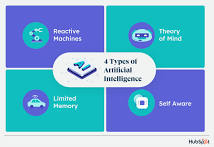
The four types of Artificial Intelligence, classified by complexity and functionality, are Reactive Machines (no memory, task-specific), Limited Memory (uses past data for decisions), Theory of Mind (understands human emotions/thoughts), and Self-Aware AI (conscious, futuristic). These categories represent the evolution from simple, single-task systems to potential human-like intelligence.
1. Reactive Machines:
These are the most basic AI systems, operating solely on present data to perform specific tasks without storing past experiences. They cannot learn and will react to identical situations the same way every time.
- Examples: IBM’s Deep Blue (chess-playing computer), spam filters, and recommendation engines.
2. Limited Memory AI:
These machines can store past data for a short period to make better predictions and decisions. Most current AI, including deep learning models, fall into this category.
- Examples: Self-driving cars (monitoring speed/distance of other cars), chatbots, and ChatGPT.
3. Theory of Mind AI:
This is a more advanced, largely experimental type of AI aimed at understanding human emotions, beliefs, and thoughts. It is designed to interact socially and adjust behavior based on emotional context.
- Status: In development/research phase.
- Examples: Research AI, social humanoid robots like Sophia.
4. Self-Aware AI:
This is the final, theoretical stage of AI development where machines possess human-like consciousness, self-awareness, and emotions. These machines would have their own desires and needs, not just mimic human behavior.
- Status: Hypothetical/Sci-fi.
To know more just click the reference link: https://www.google.com/search?q=what+is+ai+augmentation&rlz=1C1CHBD_en-GBIN1169IN1169&oq=what+is+AI+au&gs_lcrp=EgZjaHJvbWUqBwgCEAAYgAQyBwgAEAAYgAQyBggBEEUYOTIHCAIQABiABDIHCAMQABiABDIHCAQQABiABDIHCAUQABiABDIHCAYQABiABDIHCAcQABiABDIHCAgQABiABDIHCAkQABiABNIBCTEwMzU5ajBqN6gCCLACAfEFb7efyYQqOPw&sourceid=chrome&ie=UTF-8