
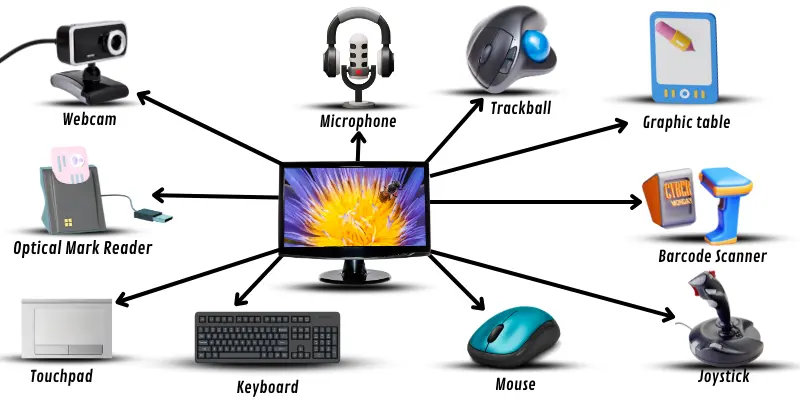
Input devices are hardware components that allow a user to send data and control signals to a computer or other information processing system. Common examples include keyboards, mice, microphones, scanners, and webcams. They translate information from the external environment into a machine-readable format that the CPU can process.
Types of input devices:
- Keyboards: Used for typing text and commands into a computer.
- Pointing devices: Used to control a cursor or navigate a graphical interface.
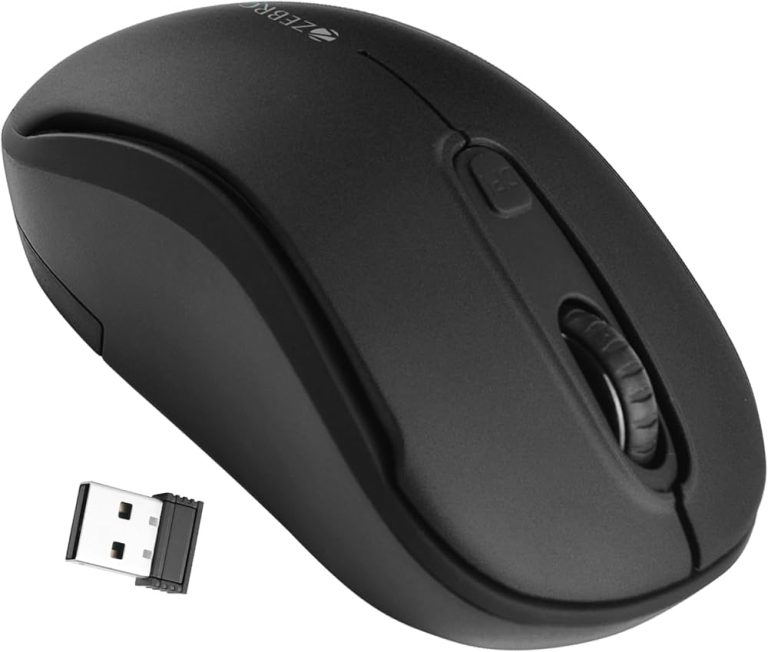
- Mouse: A handheld device that moves a pointer on the screen.
- Touchpad: A flat surface on a laptop that detects finger movement.
- Trackball: A stationary device with a ball that can be rolled to move the cursor.
- Scanners: Convert physical documents or images into digital files.
- Audio devices: Capture sound from the user.
- Microphone: Records voice or other sounds for input.
- Headphones: Can act as an output device, but can also be part of an input system (e.g., with a built-in microphone).
- Visual devices: Capture visual information.
- Webcam: A camera that captures live video.
- Digital camera: Takes still photographs or videos.
- Other devices:
- Joysticks: Used for controlling video games.
- Graphics tablets: Used for drawing and design, converting pen strokes into digital data.
- Barcode readers: Scan barcodes to input product information.
- Touchscreens: Allow users to input commands by touching the screen directly.
- Sensors: Detect physical conditions like light, temperature, or pressure and convert them into data.
What is the 10 input device?
Ten common input devices are the keyboard, mouse, scanner, microphone, webcam, joystick, touchscreen, graphics tablet, barcode reader, and light pen. These devices allow users to enter data and commands into a computer for processing.
Keyboard: Used for typing text and entering commands through a set of keys.
Mouse: A pointing device used to control the on-screen cursor, select items, and navigate.
Scanner: Converts physical documents or images into digital data that can be stored on a computer.
Microphone: Captures audio, such as voice commands or recordings, and converts it into digital data.
Webcam: Captures live video and still images, often used for video conferencing.
Joystick: A lever used to control movement in computer games and simulations.
Touchscreen: Allows users to interact with a device by touching the screen directly.
Graphics tablet: A device that allows users to draw or write digitally with a stylus, which is useful for artists and designers.
Barcode reader: Scans barcodes to quickly enter product information, commonly used in retail.
Light pen: A device used to point to a CRT monitor and select or draw on the screen by touching it.
What are input and output devices?
AI Overview

Input devices send data to a computer for processing, allowing users to control it, while output devices receive data from the computer and present it in a human-understandable form like sound, text, or images. Common input devices include keyboards, mice, and microphones, whereas common output devices are monitors, printers, and speakers. Some hardware, like a touchscreen, can function as both an input and output device.
Input devices:
- Function: Send data and control signals to a computer.
- Examples:
- Keyboard: For typing text and commands.
- Mouse: For controlling the cursor and selecting items.
- Microphone: To input sound.
- Scanner: To convert paper documents into digital images.
- Webcam: To capture video and images.
- Graphics tablet: To draw and create digital art.
Output devices:
- Function: Convert data from a computer into a human-readable format.
- Examples:
- Monitor: Displays visual information like text and graphics.
- Printer: Produces a physical copy of a document.
- Speakers/Headphones: Emit sound.
- Projector: Displays an image on a screen or surface.
Input / Output (I/O) devices:
Example: A touchscreen allows you to both tap to input commands and see the results on the screen.
Function: Can perform both input and output tasks.
What are the 30 input devices?

Thirty examples of input devices include keyboard, mouse, microphone, webcam, scanner, joystick, graphics tablet, and touchpad. Other examples are digital camera, barcode reader, light pen, touch screen, biometric devices like fingerprint readers, and optical character readers (OCR). Examples also include game controllers, VR controllers, smart card readers, and various sensors.
Common examples:
Keyboard, Mouse, Microphone, Webcam, Scanner, Joystick, Graphics tablet, Touchpad, Touch screen, Digital camera, and Game controller.
Specialized and specific examples:
- Barcode reader
- Light pen
- Magnetic Ink Card Reader (MICR)
- Optical Character Reader (OCR)
- Optical Mark Reader (OMR)
- Biometric devices (e.g., fingerprint reader, face recognition)
- 3D scanner
- Laser rangefinder
- Eye gaze tracker
- Smart card reader
- RFID reader
- VR controllers
Other examples:
- Digital camcorder
- Pen / Stylus
- Audio conversion device
- Business card reader
- CD drive
- DVD drive
- Sensor (e.g., temperature, pressure)
- Microsoft Kinect Sensor